Facia - verification & onboarding flows built on trust and low friction
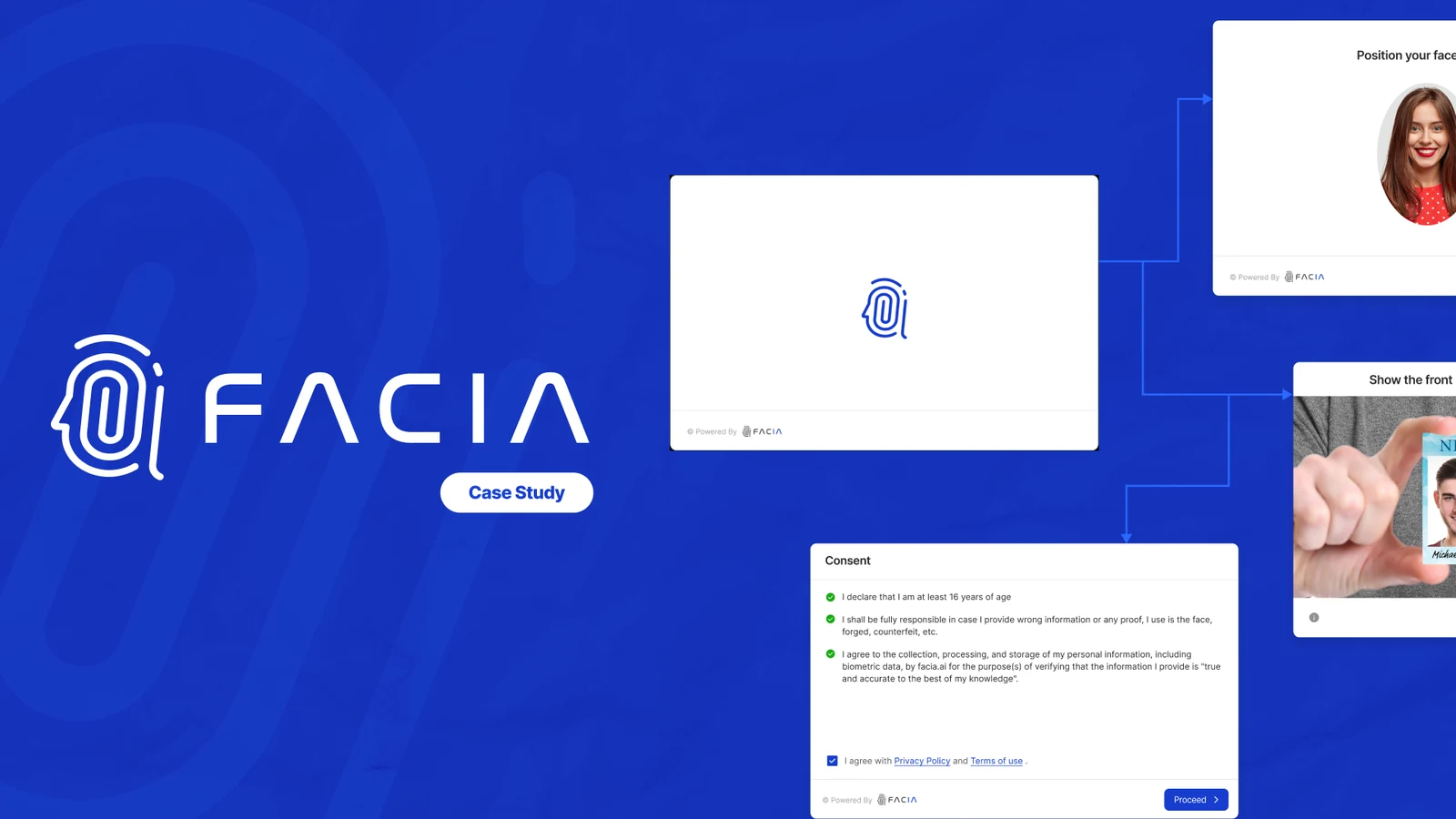
I worked on identity verification and onboarding flows - document verification, KYC/KYB journeys, and authentication steps - designed to reduce friction while keeping the experience trustworthy and conversion-minded.
- Role
- Research · Systems design
- Scope
- Rule library · Flows · Docs
- Tools
- Figma · AI research
- Industry
- Identity / KYC
- Focus
- Reuse & design ops
- Platform
- Web
- Type
- Web & SDK
01 Overview
Facia is an identity-verification product, and every new client needed onboarding flows tailored to their jurisdiction, laws, and industry. Instead of building each flow from scratch every time, I researched and built a rule-based system: pick a rule and the right flow appears, ready for a designer to assemble and ship - with client-ready documentation generated alongside it.
02 Context
Facia is an identity-verification product used by clients across many markets. Because onboarding requirements are set by regulation, they change from one jurisdiction, law, and industry to the next - so no two clients need exactly the same verification journey. As the client base grew across regions, producing those tailored flows became a recurring, research-heavy job that sat between compliance requirements and design delivery.
03 The challenge
Onboarding rules change by jurisdiction, law, and industry. Every time a client came on board, someone had to figure out the required steps and build the flow by hand.
- Each client needed a bespoke flow for their jurisdiction and laws.
- Requirements were scattered, so flows were rebuilt from scratch each time.
- Slow, repetitive, and easy to get inconsistent across clients.
- No single source of truth for what each rule actually required.
04 My role
I did the deep research and designed the system end to end. Using AI, I pulled together a wide range of jurisdictions, laws, and industries and mapped the exact steps each one required. From that, I built a rule library: select a rule and its full onboarding flow shows automatically, and adding or editing a rule is just as easy when requirements change.
05 Process
I worked from research outward - turning scattered regulatory requirements into a structured system a designer could use on demand.
Research
Used AI to compile jurisdictions, laws & industries.
Map
Translated each into its required onboarding steps.
Rule library
Structured the steps into selectable rules.
Docs
Auto-generated branded documentation per rule.
Assemble
Designers drop in screens and ship.
06 The system
The result was a self-serve rule-to-flow system. Once a rule is picked, the flow is fully visible, so a designer just takes the screens, puts them together, and delivers. Each rule also ships with documentation - an overview, the rule links, and the flow - already in Facia's branding and ready to send to the client.
- Select a rule and the full required flow appears automatically.
- Add or edit rules easily as laws or client needs change.
- Designers assemble the visible flow into screens and ship faster.
- Docs auto-ready per rule (overview, links, flow) in Facia branding.
07 Design decisions
08 Impact
Onboarding flows went from a bespoke, build-every-time task to a quick, consistent selection - saving a lot of time on every new client, keeping journeys consistent across regions, and shipping client-ready documentation built in.
09 Key learnings
- Turning one-off research into a reusable system pays back every single time a new client onboards.
- A single source of truth - the rule library - keeps flows consistent across jurisdictions and easy to update as laws change.
- Generating documentation alongside the design removes an entire handover step instead of bolting it on later.